
|
Detail |
Information |
|
Date (BS) |
Ashadh Shukla Paksha Ashtami (Ashadh 8, 2083) |
|
Tithi |
Ashtami (8th day of the bright fortnight) |
|
Observed In |
Nepal and Hindu communities worldwide |
|
Observing Communities |
Hindus, particularly Brahmins, Chhetris, and Vayu devotees |
|
Type of Event |
Religious vrat and puja dedicated to Lord Vayu |
|
Purpose |
Seek blessings from the God of Wind for health, strength, and purification |
|
Holiday Status |
Not an official public holiday |
|
Also Known As |
Vayu Asthami, Pawan Ashtami |
Quick Fact: Vayu Ashtami is observed on the 8th day of the bright fortnight in the Nepali month of Ashadh. It is a dedicated day of worship for Lord Vayu, the Vedic god of wind and the life-breath of the universe. Believers hold that honoring Vayu Dev on this auspicious tithi brings protection, purification, and renewed vitality to the mind and body.
Most of us breathe without thinking. We never stop and ask who gives us this breath? In Hindu tradition, the answer has always been clear: Lord Vayu, the god of wind and the carrier of prana (life force).
Vayu Ashtami is the day set aside to honor this invisible but indispensable deity. Falling on the Ashtami tithi (8th lunar day) of the bright fortnight in Ashadh, this observance is a reminder that the wind beneath our breath is not just air, it is divine. Devotees across Nepal and Hindu communities worldwide use this day to offer prayers, perform pujas, and reflect on the life-sustaining power of Vayu.
It may not be as widely celebrated as Dashain or Tihar, but for those who observe it, Vayu Ashtami carries deep spiritual meaning. It is a quiet yet powerful day of gratitude for the breath you just took, and the one you are about to take.
Lord Vayu is one of the oldest and most respected deities in the Hindu pantheon. His roots go back to the Rigveda, the most ancient of all Hindu scriptures, where he stands alongside Indra as one of the most powerful Vedic gods.
In Vedic tradition, Vayu holds a unique position. According to the Purushasukta, a hymn in the 10th book of the Rigveda, Vayu was born from the breath of Purusha, the cosmic being from which all existence emerged. This makes him not just a natural force, but a divine one, the very exhalation of creation itself.
In the Brihadaranyaka Upanishad, Vayu's supremacy is demonstrated through a famous contest among the gods. Each deity left the human body one by one to prove their importance. When vision left, the person became blind; when hearing left, they became deaf. But when Vayu began to leave, all the other gods were pulled out simultaneously, unable to remain without him. This story explains why the Upanishads call Vayu "Mukhya Prana", the principal life force.
Over time, his stories grew into great epics. He became the spiritual father of Hanuman in the Ramayana and the divine father of Bhima, the mightiest of the Pandavas, in the Mahabharata. Both sons inherited his legendary strength and power, a reflection of Vayu's own limitless force.
In Nepal, Lord Vayu has been worshipped for centuries. A stone sculpture of Vayu Deva stands within the premises of Gokarneshwor Mahadev Temple in Kathmandu, a quiet testament to how deeply this deity is woven into Nepali Hindu tradition. Vayu Ashtami gives devotees a dedicated day each year to reconnect with this ancient, ever-present force.
Why do people observe Vayu Ashtami? The reasons go deeper than ritual alone.
To honor the source of all life. Without Vayu, without wind and breath, no living being can survive. This day is an acknowledgment of that truth.
To seek protection from illness and harm. Vayu is revered as a purifier. Worshipping him is believed to cleanse the body and protect against disease, particularly respiratory and physical ailments.
To invite strength and vitality. As the father of Bhima and Hanuman, Vayu is associated with extraordinary physical and mental power. Devotees pray for strength, courage, and endurance.
To purify the mind and elevate consciousness. According to scripture, worshipping Lord Vayu grants freedom from lower impulses and raises the mind to a higher state of truth and awareness.
To express gratitude for prana. At its core, Vayu Ashtami is a day of thankfulness for every breath that keeps us alive.
Vayu Ashtami does not have one fixed set of rituals across all communities, but the following practices are commonly observed:
Early morning bath and purification. Devotees wake before sunrise, bathe, and dress in clean clothes, ideally in white or light-colored attire, as white is associated with Lord Vayu.
Puja and offerings at home or temple. A dedicated worship space is set up with flowers, incense, and fruits. Devotees offer prayers to Lord Vayu, chanting his Vedic mantras and hymns.
Lighting of a lamp (deepa). A lamp is lit in the puja room as a symbol of divine presence and to invite Vayu's blessings into the household.
Recitation of Vayu mantras and hymns. The Rigvedic hymns dedicated to Vayu are recited, along with prayers for health, protection, and clarity of mind.
Fasting or dietary discipline. Some devout observers fast partially or fully on this day as a mark of devotion.
Visiting Vayu-associated temples. In Kathmandu, devotees visit the Gokarneshwor Mahadev Temple, where the sculpture of Lord Vayu resides, to offer personal prayers.
Pranayama and breathing meditation. As Vayu is the god of breath, many devotees incorporate conscious breathing practices into their observance as a living form of worship.
What makes this festival matter not just spiritually, but in everyday life?
It is a reminder of what we take for granted. In the rush of daily life, breath is invisible and automatic. Vayu Ashtami brings that invisible gift into focus.
It connects us to the Vedic roots of Nepali culture. Vayu worship is among the oldest religious traditions in the Hindu world. Observing this day keeps that ancient thread alive.
It has deep ecological meaning. Honoring the god of wind is, in a very real sense, honoring the air and the natural world that sustains us. This is especially meaningful in a time when clean air is under threat.
It celebrates divine parental power. As the father of Hanuman and Bhima, Vayu represents the strength, protection, and fearlessness that parents wish for their children. Many families observe this day with blessings for their young ones in mind.
It bridges the physical and spiritual. Unlike many festivals centered on external celebration, Vayu Ashtami invites inward reflection through breath, awareness, and silent devotion.
To truly appreciate Vayu Ashtami, it helps to understand who Lord Vayu is beyond just the wind.
In Vedic cosmology, Vayu is one of the Panchamahabhuta, the five great elements that make up all of existence: earth, water, fire, air, and ether. As the embodiment of air, he is present in every living breath. He is also one of the Ashtadikpalas, the eight guardians of the eight directions, specifically governing the northwest.
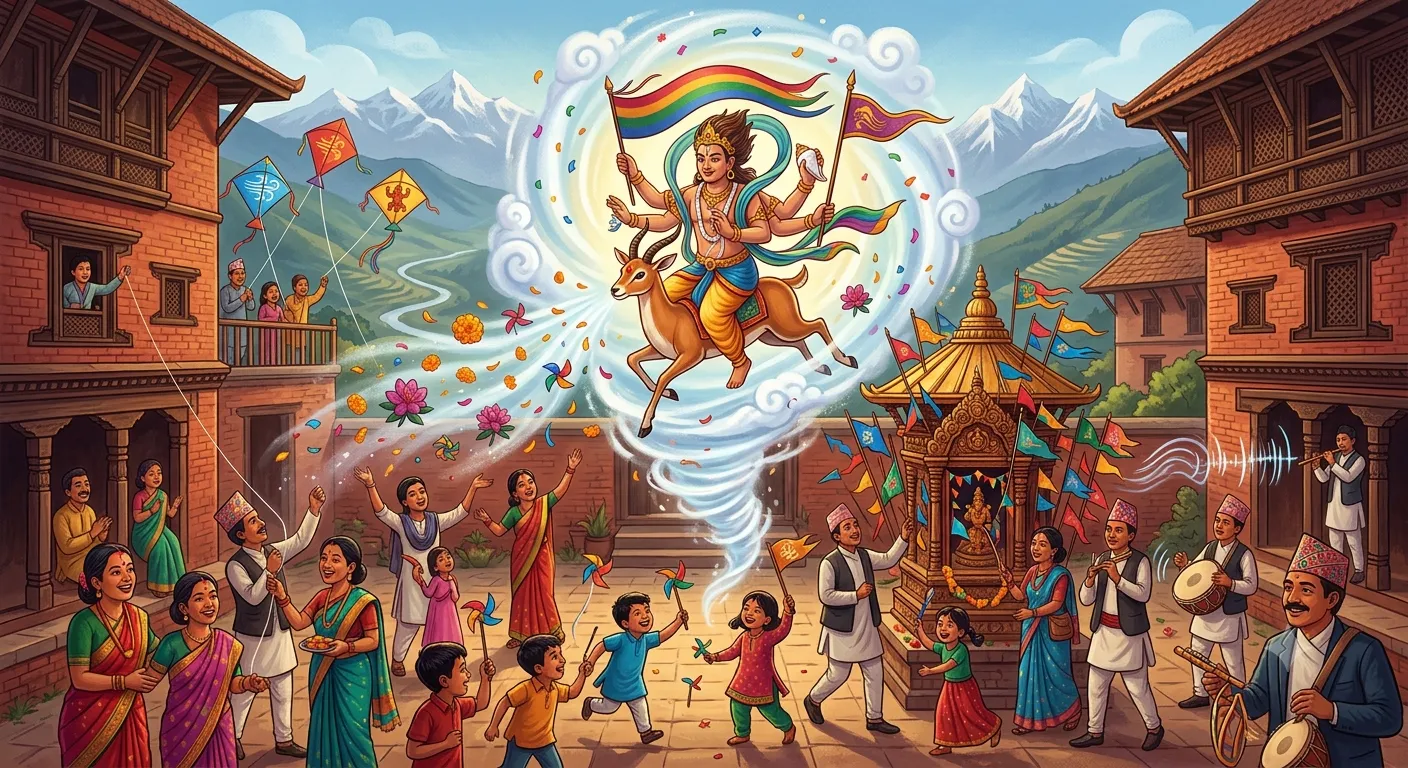
His iconography is distinctive. He is typically depicted with a crown, riding a deer or antelope (his vahana), and carrying a flag in one hand. The flowing flag represents the direction of wind and, metaphorically, the idea of finding your own path. His garments are always shown in motion, flowing in every direction.
In Nepal's Vajrayana Buddhist tradition, Vayu is recognized as a Dharmapala, a guardian deity who protects all beings. This cross-religious reverence speaks to how universal and fundamental the wind god truly is.
His Vedic name carries multiple meanings: Vata (blown), Pavana (the purifier), Prana (the breath of life), Marut (storm deity), and Anila (wind or air). Each name reveals a different dimension of his character, from the gentle breeze that cools your face to the storm that reshapes the earth.
Vayu Ashtami may not fill the streets with music or light the sky with diyas, but it fills something quieter, the lungs, the heart, and the space between thoughts.
In Nepal's rich festival calendar, every observance has a reason and a root. Vayu Ashtami is no exception. It is a day that asks us to slow down, breathe deeply, and acknowledge the force that has been sustaining us since the moment we were born.
Whether you observe it through a full puja at home, a quiet visit to the temple, or simply a few mindful breaths in gratitude, the spirit of Vayu Ashtami is always the same. It is a thank-you to the wind. And perhaps, in a world that rarely pauses, that is the most important prayer of all.