
| Date | Jyeshtha Purnima (Full Moon of Jyeshtha month, June 29) |
| Duration | Single day celebration |
| Observance | Saint veneration and cultural celebration |
| Celebrated in | Across India and Nepal, especially in Varanasi region |
| Observing Communities | Kabirpanthis, Hindus, Sikhs, social reformers |
| Type of Event | Birth anniversary of saint-poet |
| Purpose of Event | Celebrate Sant Kabir Das's teachings on equality, devotion, and the unity of all religions and communities. |
| Holiday Status | Not an official public holiday |
| First Observed in | 15th century onwards (after Sant Kabir's time, 1398-1518 CE) |
Quick Fact: Sant Kabir Das (1398-1518 CE) was a revolutionary saint and poet whose two-line couplets (Kabir Ke Dohe) were so revered that they were included in the Sikh scripture Guru Granth Sahib by Guru Arjan Dev. At his death, a miraculous phenomenon occurred — flowers appeared beneath his shroud — leading his Hindu and Muslim followers to divide his remains: half were cremated (Hindu tradition) and half were buried (Islamic tradition), symbolizing his timeless message of unity.
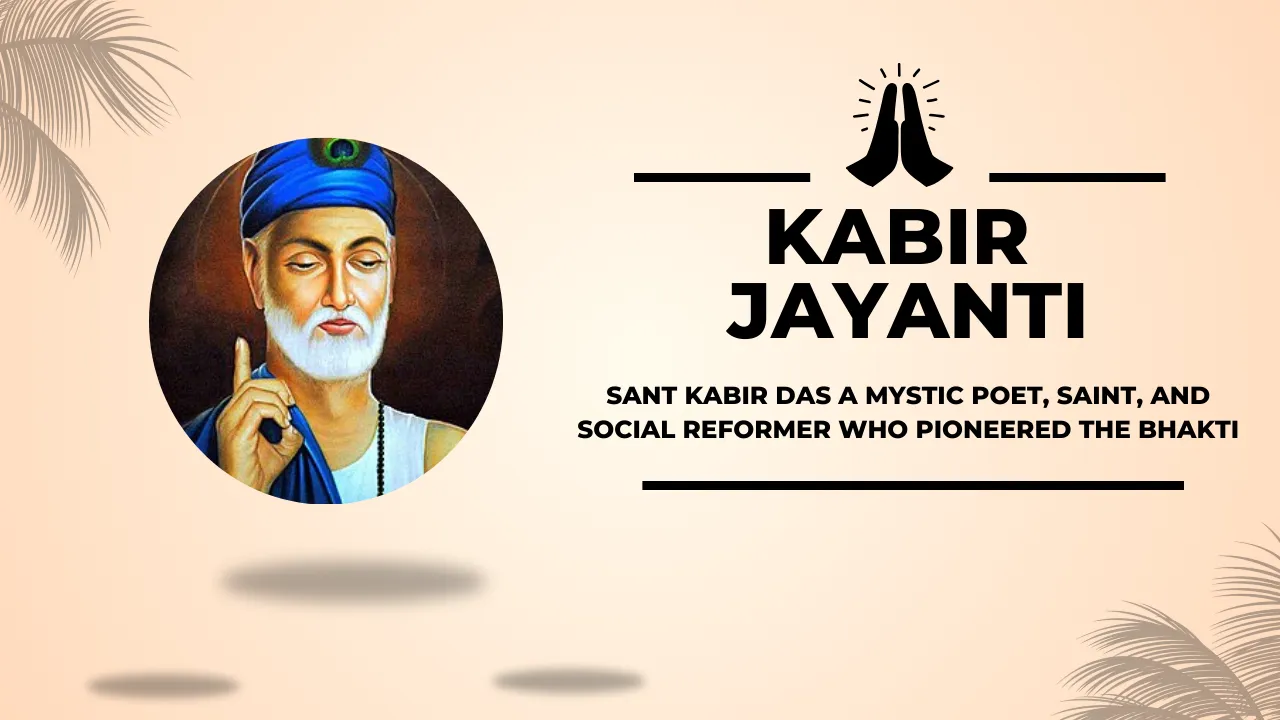
Kabir Jayanti celebrates the birth anniversary of Sant Kabir Das, one of the most beloved and revolutionary saint-poets of the Indian subcontinent. Observed on the full moon of the Jyeshtha month, this day honors a mystic who transcended religious boundaries and boldly challenged caste discrimination, religious hypocrisy, and social injustice through his luminous verses. His teachings continue to resonate across Hinduism, Sikhism, Islam, and all traditions that value truth, equality, and devotion over ritual.
History and Background
Sant Kabir Das (1398-1518 CE) was a renowned saint, poet, and social reformer born in Varanasi who bridged Hindu and Islamic traditions. Brought up by Muslim weavers but spiritually inspired by the great Vaishnava saint Swami Ramananda, Kabir challenged orthodox religious practices and the rigid caste system with equal boldness. His famous two-line couplets, the Kabir Ke Dohe , are revered across Hindu, Sikh, and Islamic traditions to this day. After his death in Maghar, a miraculous occurrence, flowers appearing beneath his shroud, led to his remains being divided between Hindu and Muslim followers, with half cremated and half buried, symbolizing unity across faiths. His verses were collected by Sikh Guru Arjan Dev and included in the Guru Granth Sahib, giving him a permanent place in three of the world's great spiritual traditions.
This day is observed to:
Honor Sant Kabir Das's revolutionary teachings, spiritual wisdom, and fearless advocacy for truth.
Celebrate his foundational contributions to the Bhakti movement and the tradition of social reform through spirituality.
Promote interfaith harmony and unity between religious communities across cultural boundaries.
Advocate for equality, human dignity, and the permanent elimination of caste discrimination.
Communities celebrate Kabir Jayanti through diverse spiritual and social activities:
Recitation and community singing of Kabir's famous couplets (Kabir Ke Dohe) at public and private gatherings.
Bhandaras — community feasts organized by Kabirpanthi followers — where all are welcomed without distinction.
Spiritual discourses and seminars on Sant Kabir's teachings, philosophy, and enduring social relevance.
Social work and charitable activities inspired by his legacy of service and compassion.
Pilgrimages and visits to Kabir Chaura (shrine) in Varanasi and other sites associated with his life.
Kabir Jayanti holds enduring significance across communities:
It commemorates a saint who transcended all religious and caste boundaries through his universal message of love.
It celebrates timeless teachings on equality, justice, and human dignity that remain deeply relevant today.
His verses are preserved in multiple religious traditions, Hindu, Sikh, and Islamic, a rare and remarkable legacy.
He inspired major social reform movements throughout Indian and Nepali history.
His teachings continue to guide spiritual seekers, social reformers, and lovers of truth across generations.
Kabir Jayanti is more than a birthday celebration, it is a remembrance of a soul who refused to be imprisoned by the boundaries of religion, caste, or convention. In an age of division, his words remain a lighthouse: "Kabir" meaning the great one who is present in all hearts. To honor Kabir is to honor the shared humanity that connects every person, regardless of faith or background.